20 Agentic AI Terms Developers Should Understand
A plain-English glossary covering agents, tools, memory, RAG, planning, MCP and human approval.
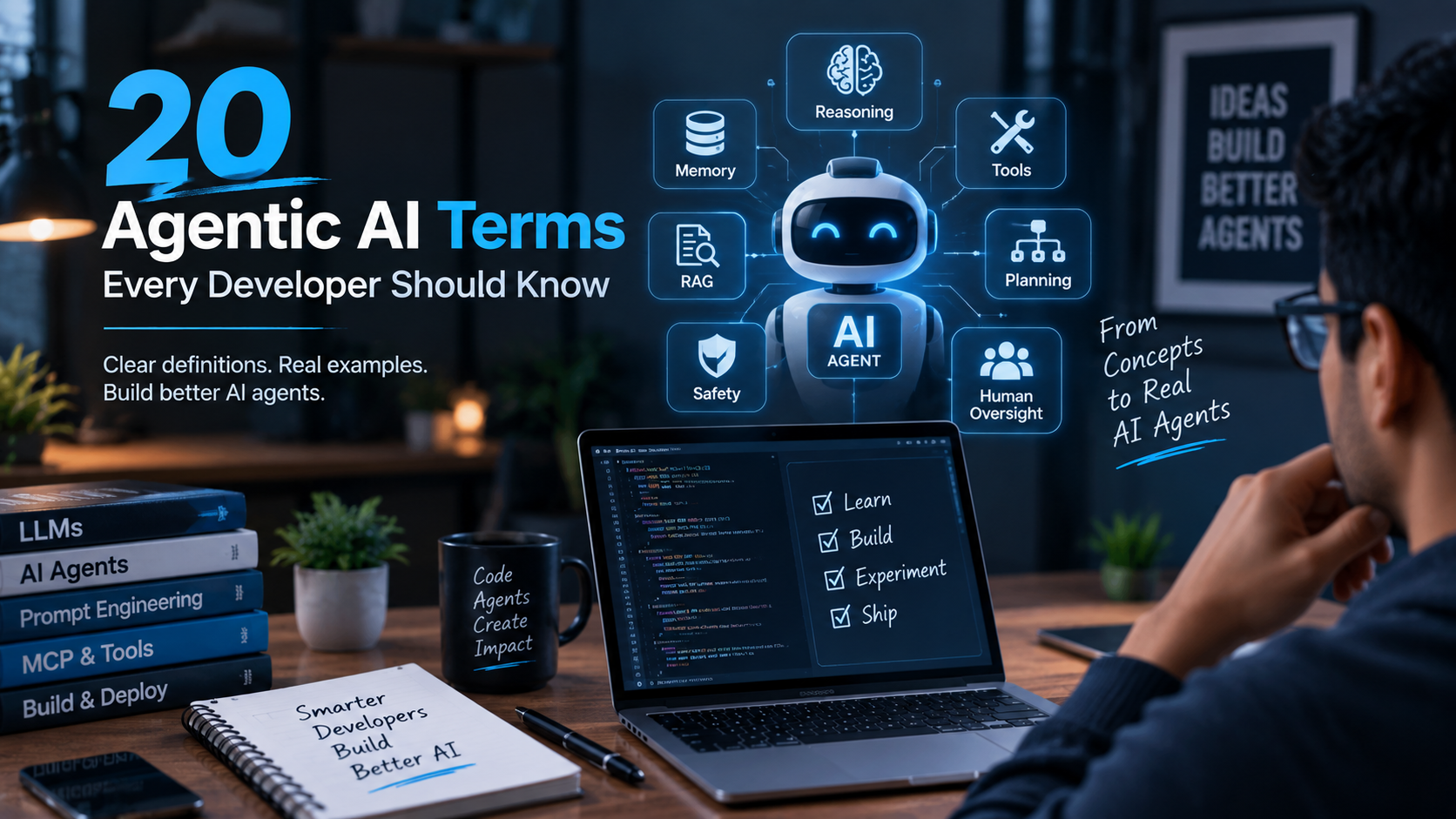
Agentic AI describes systems that can pursue a goal through several steps, use tools, inspect results and adjust what they do next. Developers working with these systems need more than model vocabulary. They also need to understand execution, permissions, memory and observability.
This condensed glossary covers the essentials. For expanded explanations and architecture examples, see the complete agentic AI terms guide.
Core Concepts
- AI Agent
An AI agent is a system that uses a model to interpret a goal, select actions and interact with tools or software. The surrounding application controls which actions are actually available.
- Agentic AI
Agentic AI is the broader design pattern behind systems that plan and act with some degree of autonomy. It does not mean the model has unlimited control.
- Agent Loop
The agent loop is the repeated cycle of observing a state, reasoning about it, choosing an action, executing that action and inspecting the result.
- Goal
A goal describes the result the agent is trying to achieve. Clear goals need limits, success conditions and stopping rules.
- Planning
Planning breaks a larger goal into smaller actions. Plans may change when tools return new information or an action fails.
Tools and Execution
- Tool Calling
Tool calling lets a model request a structured function, such as searching a database, reading a file or sending an API request. Application code must validate the arguments and permissions.
- Model Context Protocol
Model Context Protocol, or MCP, is a standard for connecting AI applications with tools, resources and external services. MCP provides interoperability, not automatic security.
- Orchestrator
An orchestrator manages the agent workflow. It passes context, selects specialised components, handles retries and records state.
- Workflow
A workflow is a defined sequence of steps. It is usually more predictable than an open-ended agent loop and may be safer for fixed business processes.
- Human in the Loop
Human-in-the-loop design requires a person to review or approve selected actions. It is most useful for payments, deletion, permission changes and public communication.
Context, Knowledge and Memory
- Context Window
The context window is the information available to the model during one request. It is temporary and limited in size.
- Retrieval-Augmented Generation
RAG retrieves relevant material from external sources and supplies it as context. Retrieval is not the same as long-term memory.
- Short-Term Memory
Short-term memory holds information needed during the current task or session, such as completed steps and recent tool results.
- Long-Term Memory
Long-term memory preserves selected information across sessions. Memory writes require validation and provenance because false information can persist.
- State
State records the workflow's current position, inputs, outputs, decisions and pending actions. Reliable state handling is essential for recovery and audit.
The developer glossary for agentic AI includes deeper comparisons between context windows, RAG and memory.
Reliability and Security
- Guardrail
A guardrail is a control that constrains inputs, outputs or actions. Examples include schema validation, tool allowlists and content checks.
- Least Privilege
Least privilege means giving an agent only the tools, data and operations required for its current task.
- Observability
Observability makes the system's behaviour inspectable through traces, tool-call logs, timing, errors and outcomes.
- Evaluation
Evaluation measures whether the agent completes tasks correctly, safely and consistently. It should test complete workflows, not only model responses.
- Agent Handoff
An agent handoff transfers work from one agent or component to another. The receiving component should verify the request, identity, context and permissions instead of trusting every message automatically.
These terms are connected. RAG supplies context, memory preserves selected information, tools create effects and guardrails limit what can happen. Keep the full 20 agentic AI terms reference available when designing or reviewing an agent architecture.